Volume Imaging Solutions
Verasonics Offers Researchers the Most Versatile and Comprehensive Volume Imaging Solutions Available Today
Three-dimensional volumetric image acquisition and analysis is a leading-edge application in ultrasonics research. Rapid data acquisition is essential in many biomedical applications, requiring high frame rates and specialized transducers supported by precisely synchronized high-channel-count electronics.
Verasonics is an experienced leader in the acquisition of volume imaging data, offering a variety of solutions for use across a wide range of studies, including a single system solution, as well as 2- and 4-unit multi-system configurations.
Volume Imaging Packages & Software
Volume Imaging solutions from Verasonics have been developed to enhance and extend the work of today’s scientific community. Volume Imaging Essential and Expansion Packages, combined with appropriate transducers and UTAs, can facilitate advanced research efforts. Package offerings:
For a two-system configuration, the Essential Package includes two Volume Imaging RDMA licenses, data cables, and a Vantage NXT Multi-System Synchronization Module.
For a four-system configuration, the Expansion Package includes two additional Volume Imaging RDMA licenses, 4 host controllers, data cables, a multi-system rack assembly, and remote installation support.
Verasonics provides the software required for the acquisition and reconstruction of volumetric data. The software includes scripts for a variety of 3D acquisition techniques, such as plane wave, wide beam, and random-aperture compounding imaging, as well as color Doppler imaging using matrix array transducers. Verasonics also offers scripts for volumetric acquisition using row-column array transducers.
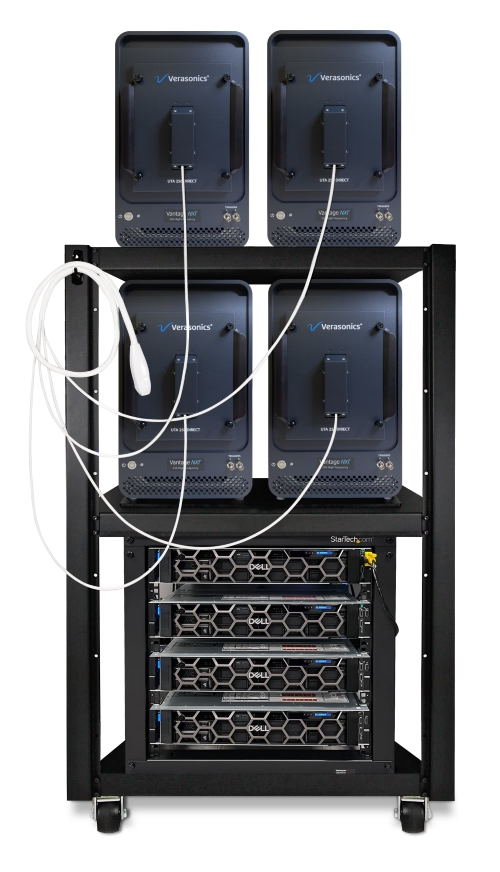
Vantage NXT 1024-channel Multi-System configuration
Potential Benefits of High-Frame Rate Volume Imaging
Benefits of a Multi-System Configuration for Volume Imaging
Volume Imaging Options
| System Configuration | 1 System | 2 System | 4 System |
|---|---|---|---|
| Vantage NXT 256 System (MF/HF) | 1 | 2 | 4 |
| Number of Receive Channels | 256 | 512 | 1024 |
| Maximum Number of Connected Elements | 1024 | up to 2048 | up to 4096 |
| Host Controllers | 1 | 2 | 4* |
| Volume Imaging Package - Essential | ✓ | ✓ | |
| Volume Imaging Package - Expansion | ✓ |
*One primary / Three secondary
Single System, 256-Channel Solution
A single Vantage NXT 256-channel system can be connected to different subsets of matrix array elements on transmit and receive to obtain synthetic aperture ultrasound data. The data can be processed by the Vantage NXT system software to yield volume image reconstructions. To obtain larger aperture data from matrix array transducers, multiple Vantage NXT systems can be synchronized to provide up to 1024 channels of acquisition data.
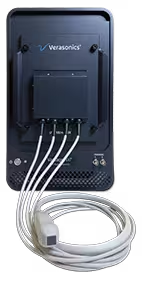
Vantage NXT with UTA 1024-MUX and Matrix Array Transducer
Multi-System Solutions
A researcher can start with one Vantage NXT system and later acquire additional systems that can be synchronized to provide a larger number of acquisition channels. A 2-system configuration would provide researchers with 512 receive channels, providing data from up to 2048 elements with a 2 x 1024-MUX adapter.
The 4-system configuration of the Vantage NXT has 1024 transmit and receive channels, with the potential for up to 4096-element signals with a 4 x 1024-MUX adapter. The most comprehensive volume imaging offering from Verasonics, it enables the fastest possible data acquisition from high-element-count matrix arrays.
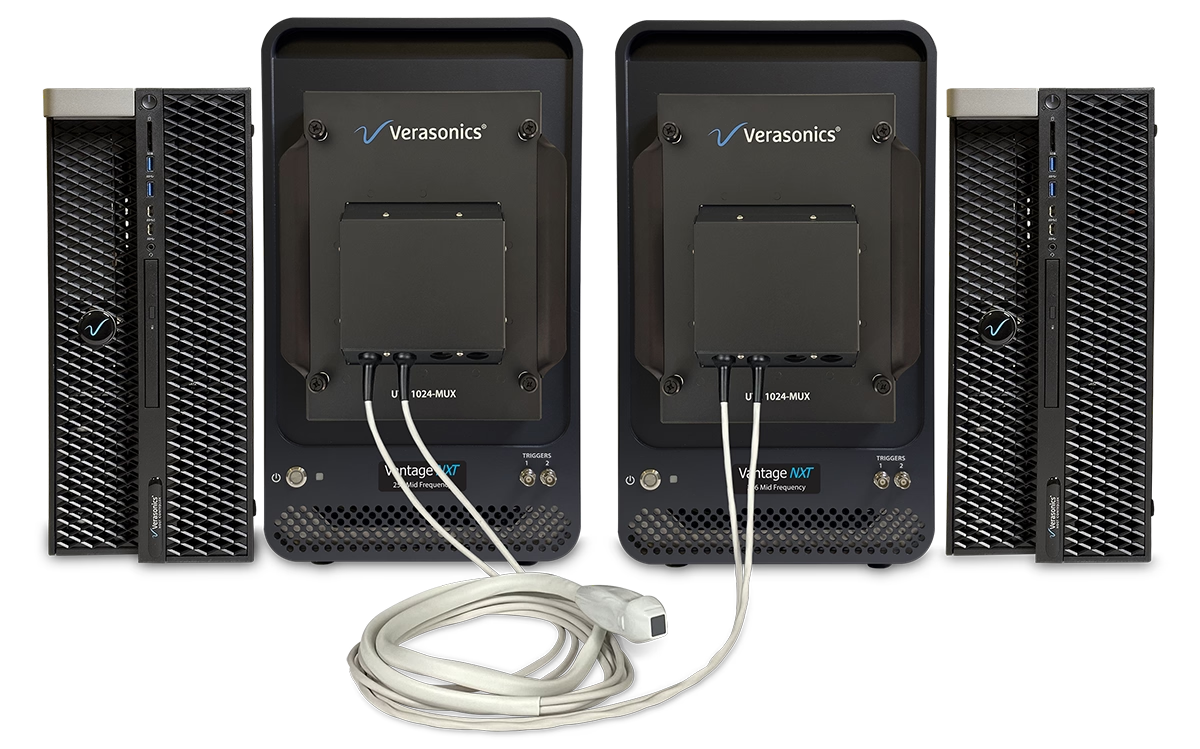
Vantage NXT 2-unit Multi-System
Volume Imaging Transducer Options
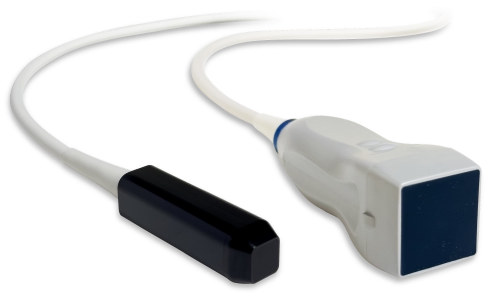
Matrix Array Transducers
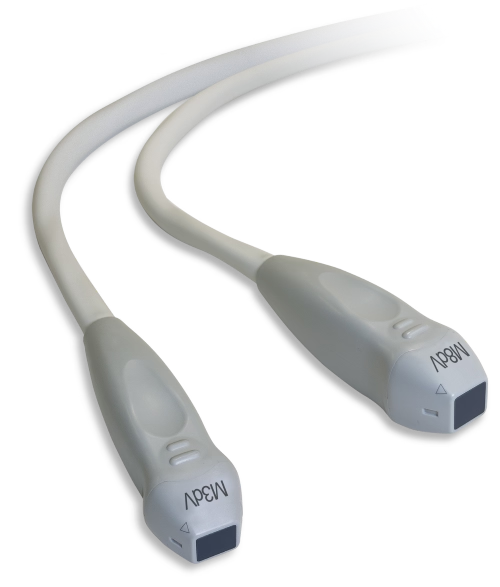
Matrix Arrays are a leading-edge transducer technology that enables ultrafast acquisition of volume data. Available in 3 and 8 MHz models, these transducers are compatible with Vantage NXT 256 Research Ultrasound Systems.
| M3dV | M8dV | |
|---|---|---|
| Center Frequency | 3.0 MHz | 8.0 MHz |
| Bandwidth | >50% | >50% |
| Number of Elements | 1024 (32×32) | 1024 (32×32) |
| Pitch | 0.3 mm | 0.3 mm |
| Elevation Aperture | 9.6 x 9.6 mm | 9.6 x 9.6 mm |
| Cable Length | Main cable = 1m; sub cables = 1m | Main cable = 1m; sub cables = 1m |
| UTA Compatibility | UTA 1024-MUX or UTA 256 Direct | UTA 1024-MUX or UTA 256 Direct |
Row-Column Array Transducers
Row-Column Arrays, available in 6 MHz and 15 MHz models, can provide a cost-effective approach to high-frame-rate volume imaging. They can be used for 3D imaging and do not require multiplexing. Both are compatible with the Vantage NXT 256 systems, using the UTA 408-GE adapter.
| RC6gV | RC15gV | |
|---|---|---|
| Center Frequency | 6.0 MHz | 15.0 MHz |
| Bandwidth (-6dB) | >90% | 80% |
| Number of Elements | 256 (128×2) | 160 (80×2) |
| Pitch | 0.2 mm | 0.11 mm |
| Element length | 25.6 mm | 8.8 mm |
| Active Aperture | 25.6 x 25.6 mm2 | 8.8 x 8.8 mm2 |
| Cable Length | 2 m | 2 m |
Vantage NXT Multi-System Synchronization Module
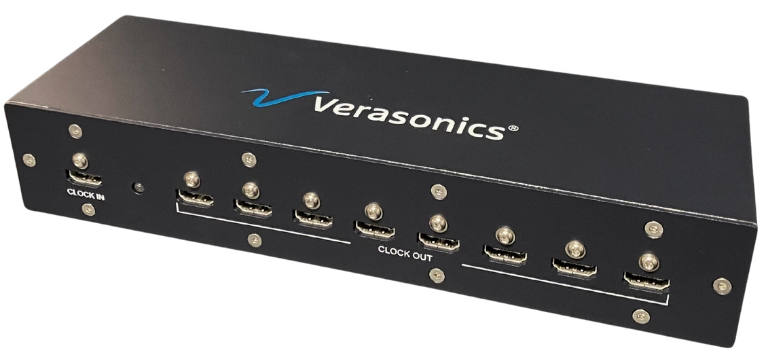
One challenge in combining multiple systems for research or product development is the synchronization of transmit and receive clocks for each system for phase-accurate image reconstruction. The Multi-System Synchronization Module allows users to synchronize the 500 MHz system clocks in individual Vantage NXT systems to within 1ns.
Vantage NXT Multi-System configurations define one system as the primary, with one or more secondary systems. Identical conditionally programmed scripts run on each system, and sequences are synchronized through the module. High-speed networking adapters transfer RF or partially beamformed IQ Data from the secondary systems to the primary host controller using RDMA technology. A typical sequence would perform partial image reconstruction on each of the host controllers with a final summation and display on the primary host controller.
This Synchronization Module is included in the Volume Imaging Packages. It may also be helpful for applications other than volume imaging that require phase-accurate synchronization between multiple Vantage NXT systems.