Essentials of Ultrasound Imaging Course
Verasonics, the leader in research ultrasound, offers the Essentials of Ultrasound Imaging Course – a complete solution created for institutions or organizations interested in a comprehensive ultrasound curriculum. This unique, ‘ready-to-teach’ course provides everything needed to offer a graduate-level ultrasound course, including the basic physics and instrumentation needed to understand pulse-echo imaging.
The course allows students and industry professionals lacking knowledge about basic ultrasound concepts to couple the education of ultrasound theory with hands-on experiences using the Vantage® and Vantage NXT Research Ultrasound Systems in a laboratory setting. This might include scientists and engineers from other disciplines, physicians, sonographers, managers of research or engineering groups, and those curious about ultrasound science.
The Essentials of Ultrasound Imaging Course is packaged as a full educational solution, designed to be taught by an experienced instructor at an academic institution or commercial organization. This is not a product training course. System training videos are available on the Verasonics Community Portal for Verasonics customers.
Essentials of Ultrasound Imaging Package
Curriculum packet: 10 lecture modules, 9 lab modules, lab instructor manual
Essentials of Ultrasound Imaging Simulators: 27 interactive, near real-time simulation programs in executable form for Windows and macOS, with instruction manual (No extra licenses needed)
Essentials of Ultrasound Custom Phantom with a set of special targets that reinforce physics concepts through student labs
Essentials of Ultrasound Imaging, by Szabo & Kaczkowski (Elsevier, 1st Edition )
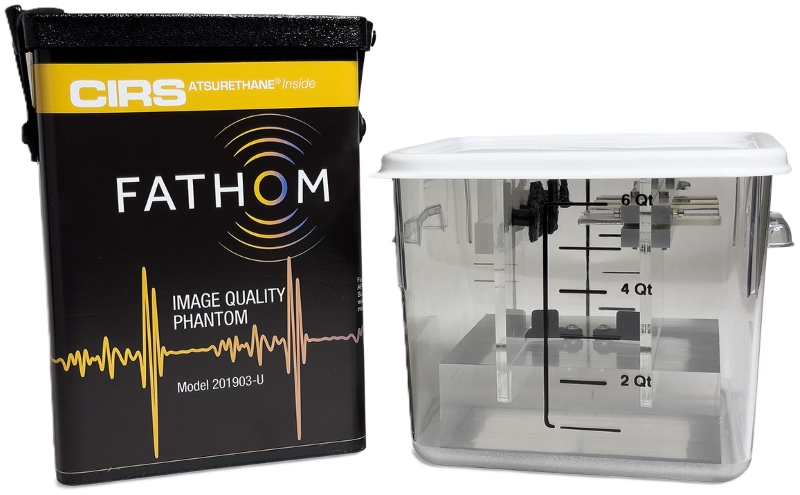
Custom imaging phantom included, optional imaging-resolution phantom available through Verasonics
Hardware/Software Prerequisites
Vantage or Vantage NXT 64, 64LE, 128, or 256 (Standard or High Frequency — Image Reconstruction option required for Systems with 64 channels)
UTA 260-S, 260-D, or 260-MUX
L11-5v Linear Array Transducer
MATLAB (version 2022a or newer)
Imaging-resolution Phantom (similar to CIRS Fathom Image Quality Phantom)*
*Contact Verasonics for the availability of this phantom
Student Requirements
Students must secure these elements before starting a course:
Essentials of Ultrasound Imaging, by Szabo & Kaczkowski (Elsevier, 1st Edition )
Essentials of Ultrasound Imaging Simulators*– download the WIN or MacOS version from Verasonics, free of charge
*Simulator packages have a fixed expiration date
Overview
The Essentials of Ultrasound Imaging Course is a fast-track introduction to the science, physics, and technology of ultrasound imaging systems. The presentation of the material is unique in two ways:
1
Principles introduced in the provided lectures are illustrated through interactive software simulators that embody key equations, allowing students to engage with the concepts with minimal mathematical background and gain understanding that normally requires significant mathematical sophistication. Knowledge of MATLAB® scientific programming language is not required.
2
The concepts are demonstrated with Verasonics Research Ultrasound Systems through software scripts and laboratory imaging kits designed for this course. The use of the Vantage and Vantage NXT System provides unparalleled insight into each step of ultrasound image creation, including signal processing, transducer operation, different types of beamforming, and image formation. Imaging principles are brought to life through hands-on experiments that yield quantitative results.
A comprehensive overview compares the major functional blocks of two types of ultrasound imaging systems:
A commercial system with delay and sum hardware beamforming tailored to scanline imaging.
The programmable Vantage and Vantage NXT Research Ultrasound Systems have a unique and flexible software-based architecture.
Signal processing, beamforming, and imaging formation are described and experienced through interactive modules and laboratory exercises. Interactive simulators demonstrate the basics of wave propagation, refraction, reverberation, reflection, scattering, imaging, and Doppler imaging. In addition, an introduction to transducers, diffraction, acoustic fields (both continuous wave and pulsed), focusing, plane wave compounding, power law absorption, and heating is included. The course builds on the principles presented to introduce advanced topics and growth areas in ultrasound research.