Software Capabilities

The Verasonics software suite is at the core of the Vantage and Vantage NXT Ultrasound Research System and provides:

Flexible programming environment using the MATLAB programming model or Acquisition SDK

Open architecture with full access to system parameters for data acquisition, custom imaging, and signal processing

Comprehensive real-time imaging modes supporting B-mode, Doppler, Elastography, Photoacoustic imaging, and more

High-performance data handling with advanced tools for offline analysis and visualization

An interactive help system, integrated into MATLAB Document Editor, that provides quick reference to over 400 structure names, attributes, and keywords to facilitate script development and reduce runtime errors.

Ultrasound Simulator Software

The purchase of every Vantage NXT and Vantage system includes a hardware license to operate the system, as well as five additional Simulator licenses that can be installed on other computers used by lab members.

The Verasonics Simulator software tool enables users to develop and test MATLAB-based programming structures, even without being connected to the acquisition system, allowing multiple users to work in parallel. The Simulator supports visualization of the sequence of events and data acquired from RF to IQ to image data, including 3D images, on any number of channels, even more than are available on the acquisition hardware system.

To learn more, visit our Ultrasound Simulator Software page.

Software Toolboxes

Each Vantage NXT Research Ultrasound System includes a variety of utilities and software tools that support the development and debugging of scripts for sequence programming. These tools complement a library of more than 500 example scripts that demonstrate programming techniques, research applications, and featured functionalities.

Over the years, Verasonics has continued to expand this library of tools and example scripts. Here is a sampling of the most popular tools:

A color map facilitates the perception of subtle variations in tissue texture. Allows users to adjust the gamma curve of the display window and visualize the effect on the image in real-time. Up to five curve plot settings can be saved for different tissue imaging needs.

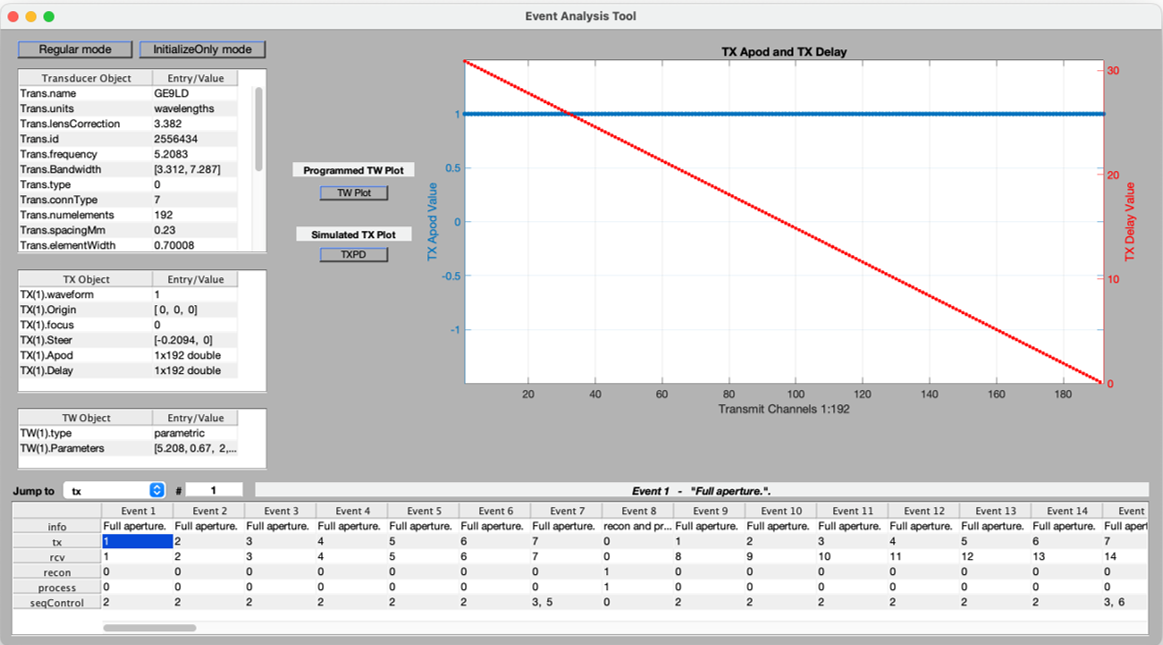
The Event Analysis tool assists with developing and debugging a setup script. Displays all events in a sequence after running a SetUp script and allows users to click any event to inspect its associated structures in MATLAB.
The preSetTool is used to save the configuration of the UI controls, as shown in the VSX Control GUI for most example scripts, PTool, ColorMapTool, filterTool, and some predefined UI controls using VsSlider and VsButtonGroup definition. After optimizing for a particular application, the user can save all UI controls, such as TGC, TGC All Gain, Digital Gain, Range, and Speed of Sound, as a preset for easy reuse without manual adjustment.

The Process Tool, or PTool, supports modification of the image-processing parameters.
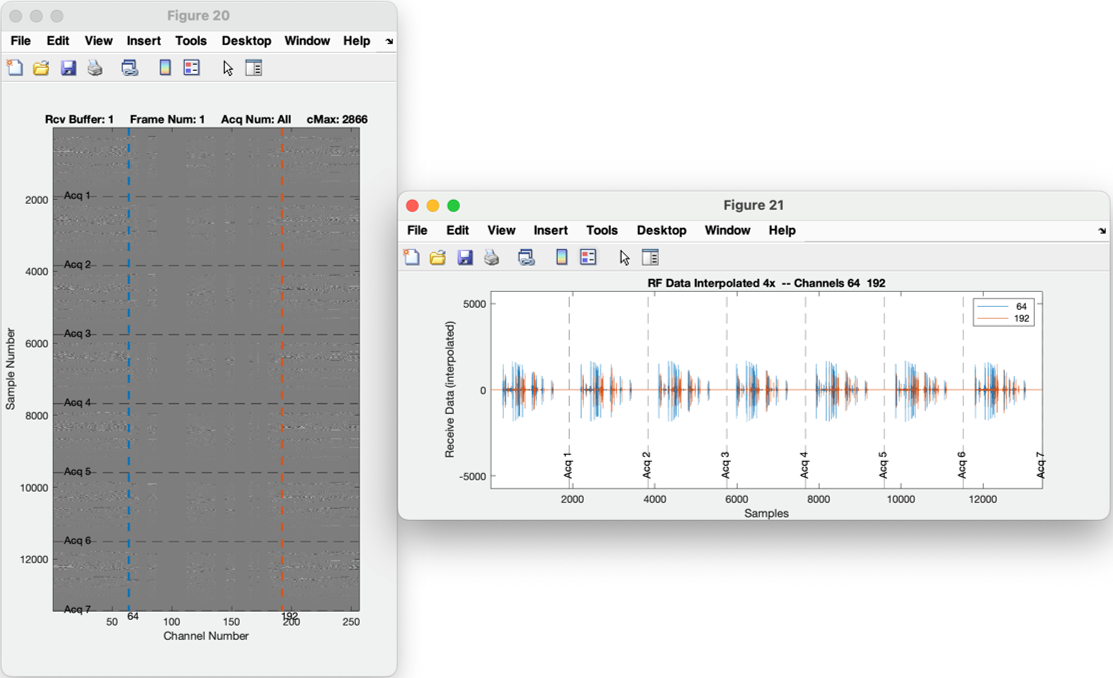
The RF Data Viewer Tool provides grayscale visualizations and line plots of RF data stored in the RcvData buffer.

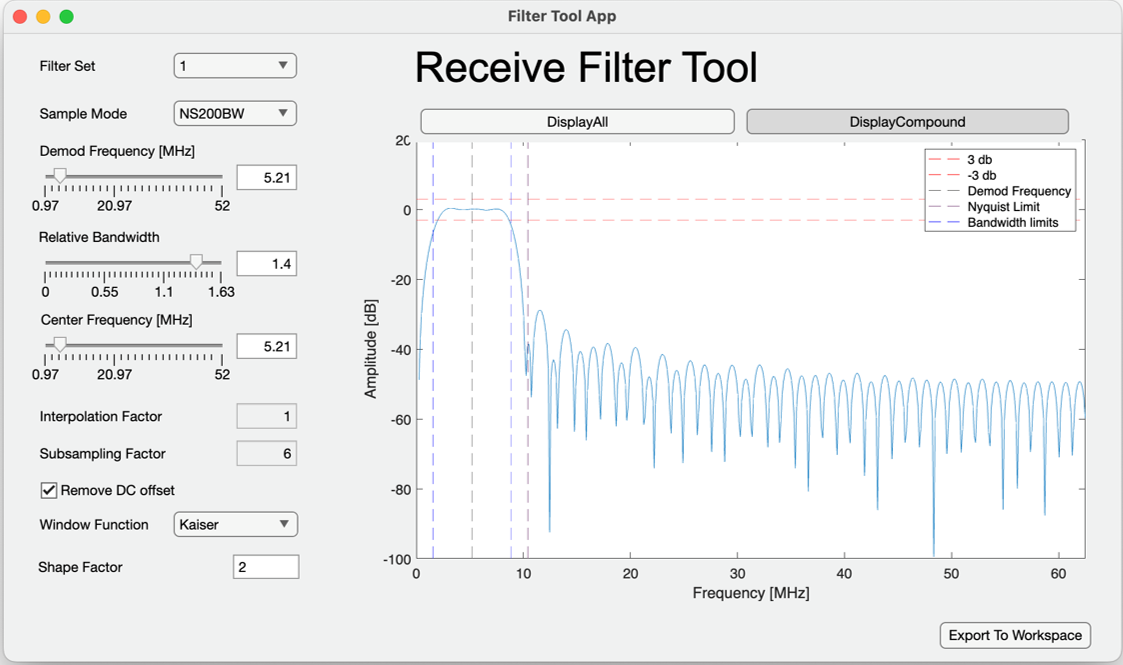
Enables the user to customize filter parameters and observe the corresponding filter response.

The Save RF tool allows the user to save RF data to a desired location for post-processing. 

This tool provides a dedicated environment for advanced elastography research using the L7-4 Linear transducer. This sequence script allows to generate Acoustic Radiation Force (ARF) pushes and tracking shear waves via high-speed plane wave imaging. You have complete visibility and control over the specific code, enabling real-time adjustments to push pulse duration, transmit voltage, and the tracking region of interest. Designed for researchers who need more than standard settings, it allows to reposition the push focus on the fly or integrate your own custom external functions for wave generation.

This tool allows the user to visualize the Trans, Media, and PData structures in a single 3D coordinate system. If no argument is provided, a new figure is created.

Allows developers to easily visualize transducer characteristics for probe integration and testing with the Vantage NXT system.

This tool allows the user to visualize the pixel data or pixel regions that were defined in the setup script, and that will be use during the reconstruction process

When a TX structure is present in the MATLAB workspace, invoking the showTXPD tool produces and displays beam plots of the transmit beam that are produced by each individual TX structure.

Frequently Asked Questions

Learn more about Verasonics’ software architecture and capabilities. This information will assist current and potential users in gaining a broader understanding of the Vantage & Vantage NXT Research Ultrasound Systems.

The Verasonics’ software provides the user with full control over all components of an ultrasound system. This allows the user to experiment with custom transmit waveforms, unique scanning sequences, and new processing methods.

The software allows users to program a virtual ultrasound system that completely abstracts the hardware and software components into objects whose attributes are easily specified. And as they become familiar with the MATLAB®-based Verasonics programming interface, users can very quickly implement their ideas for new ultrasound modalities.

Verasonics offers two options:

MATLAB is a high-level language used for sequence programming and user-programmed signal and image processing. MATLAB was chosen based on its widespread use in academic institutions and their research labs, and its rich set of built-in functions for data processing, image display, and user interface development.

In addition, functions coded in other languages such as Python, Java, .NET, Fortran, C, and C++ are easily integrated with MATLAB to supplement the processing environment.

Verasonics also offers the Acquisition SDK that allows users to program sequences using the C programming language, without requiring MATLAB. The SDK focuses on data acquisition and does not include post-processing functions like reconstruction, beamforming, or image display. This option is only available with the Vantage NXT platform.

The MATLAB language is used only for specifying the sequence programming of the Verasonics Systems and for user interface controls. The acquisition of ultrasound data is controlled by a hardware sequencer that operates completely independently of the software, ensuring deterministic timing of acquisition events. All software processing functions provided by Verasonics are programmed in C or C++ for speed of execution and incorporated into a MEX function (MATLAB External processing function) that is called at the start of sequence execution.

In the C environment, processing is highly optimized using multiple threads of execution and SIMD (Single Instruction Multiple Data) vector instructions, enabling real-time software image reconstruction, Doppler processing, and image display processing. The MATLAB programming environment is only re-entered for changes in system programming or execution of user-provided processing functions, which, if desired, can also be coded in C or other supported languages.

Any program that is compatible and integrates with MATLAB to allow calls of MATLAB functions can be used to control the Vantage and Vantage NXT systems. MathWorks provides an API (Application Programming Interface) for Python that allows Python to call MATLAB as the computational engine. The MathWorks support site has a number of examples for using MATLAB with LabView.

The Acquisition SDK is comprised of C-language functions, documentation, and examples that enable users to create and execute acquisition sequences on the Vantage NXT System.  It offers a stable binary interface accessible to common programming languages.

The Verasonics’ software provides the user with full control of all transmit and receive data acquisition parameters, including transmit waveform generation, receive amplifier characteristics, A/D sample rate, and post-digitizer filtering and signal conditioning.

Yes – the digital data from all receive channels is stored in host memory and can be accessed by user-provided functions.
Yes – as mentioned earlier, the user can write their own processing functions in a variety of languages that can be called at defined points in a sequence of events, and access acquired or partially processed data.

The Vantage and Vantage NXT reconstruction software compute the complex echo signal value at points in the medium imaged by the transducer. The signal value represents the returned echo of the transmit waveform from the media point, as received and focused by the aperture of receiving elements. Multiple acquisitions can be processed and combined for synthetic aperture applications or for frequency or spatial compounding. Geometric regions in the media can be defined to restrict processing to specific spatial locations. View the Verasonics Image Reconstruction Option data sheet.

This is possible with proper formatting of the ultrasound data. The format would need to be identical to the format of the acquired data obtained using a sequence program written for Verasonics Systems. In other words, individual channel data sampled at the sequence-defined rate and length could be stored in a Verasonics software receive buffer and loaded into the system software for processing.

Over 400 example scripts are provided with the software for programming various transducer types for a variety of scanning methods. Many transducers have high image quality example scripts that can be used to obtain diagnostic quality images. All of these examples can be used as provided, or can be modified by the user to develop new techniques.

Several researchers have developed breakthrough applications using Verasonics Systems and commercialized them.

Verasonics licenses its technology to companies, both large and small, for use in their commercial products. We have made several improvements to make it easier for our licensees to replace the MATLAB interface with their own graphical user interface that communicates with our lower-level software. Other researchers have ported their applications for use on other ultrasound systems.

Verasonics also offers the Acquisition SDK that allows users to program sequences using the C programming language, without requiring MATLAB. The SDK focuses on data acquisition and does not include post-processing functions like reconstruction, beamforming, or image display. This option is only available with the Vantage NXT platform.